
Challenges Successful Entrepreneurs Face and How They Use Wealth Advisors

Challenges Successful Entrepreneurs Face and How They Use Wealth Advisors
Before building her billion-dollar empire, Sara Blakely, founder of Spanx, spent seven grueling years selling fax machines door-to-door. Her journey to famous self-made millionaire proves success relies on a mindset of resilience. Learning how to develop an entrepreneurial mindset means embracing constant rejection until you finally build a profitable business. However, reaching that massive financial milestone is only half the battle.
Industry data reveals that sudden fortune introduces hidden complexities that income alone cannot solve. Building a company requires wealth creation, but protecting those assets demands “wealth stewardship”, the entirely different skill of preserving capital rather than risking it. Successful entrepreneurs quickly realize scaling a legacy requires transitioning from a scrappy founder to a disciplined steward. Navigating these new logistical hurdles is exactly why they rely on specialized wealth advisors.
The Complexity Trap: Why Scaling a Business Creates New Financial Risks
We often assume more sales automatically mean fewer problems, but success holds a hidden trap. When scaling a company from scratch, your larger business engine requires significantly more financial fuel to run. This creates a scalability constraint, a frustrating ceiling where revenue looks high on paper, but actual cash flow is tied up in new inventory and expanded payroll. To avoid burnout, effective growth strategies for small business owners must include stepping back from doing the daily work to entirely delegating it.
Compounding this pressure is a hurdle called “asset fragmentation.” As operations expand, your money scatters across physical equipment, new property, and uncollected invoices, making cash incredibly difficult to access. Without implementing solid risk management techniques for new ventures, this scattered foundation drastically increases your personal liability. A single business dispute could unexpectedly threaten your family savings if your legal boundaries are not properly reinforced.
Overcoming these obstacles proves that building a company and protecting wealth are entirely different skills. Eventually, successful founders realize they cannot operate a growing business and shield their profits alone, requiring a distinct shift from accumulating cash to actively managing and protecting it.
How Wealth Advisors Protect Legacies: The Difference Between Having Money and Managing It
Imagine hitting your financial goals, only to watch that hard-earned money slowly drain away. This silent leak is known as “wealth erosion,” a frustrating reality where inflation, hidden liabilities, and taxes quietly eat your profits. While an entrepreneur naturally focuses their energy on creating success, an asset manager focuses entirely on preserving it. Trying to do both is like attempting to build a ship during a hurricane; the emotional burden of constant financial decision-making almost always leads to costly mistakes.
To stop this drain, successful founders embrace professional Wealth Management firms, like Satovsky Asset Management, who step in to remove the guesswork, applying strict risk management techniques for new ventures that individual investors often miss. We protect your hard work by executing the 3 Core Pillars of Professional Wealth Management:
- Tax Optimization: Minimizing what you owe so more capital stays in your pocket.
- Risk Diversification: Spreading investments out so a single market failure doesn’t set you back by years.
- Estate Planning: Establishing clear directives for your family’s inheritance.
Delegating these heavy complexities effectively neutralizes the stress of managing a personal fortune. With a safety net securely in place, leaders can redirect their focus back to their true talent: building their company. Once personal assets are secured, founders often seek outside money to fuel their next massive leap, shifting their focus toward rapid growth and external funding.
From Bootstrapping to Venture Capital: Navigating the High-Stakes World of Rapid Growth
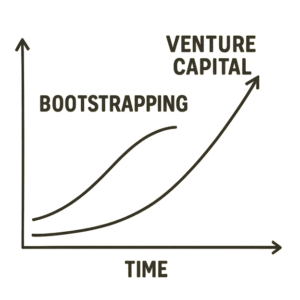
Every business eventually faces a crossroads: build slowly on your own dime or take outside money. When weighing bootstrapping versus venture capital funding, the choice pits control against speed. Bootstrapping lets you remain the absolute boss. Conversely, venture capital acts like high-octane fuel; it accelerates growth massively but requires a crucial mindset shift. You are no longer an independent owner; you become a partner answering to investors.
Still, driving a fueled engine the wrong way is exactly what causes most startups to fail. To survive, founders must discover their “product-market fit.” Imagine your product is a key and the market is a lock. If it doesn’t turn, you don’t force it—you find a different lock. Consequently, pivoting business models for market fit is never a failure. It is an essential survival skill used to adapt quickly before funds disappear.
Navigating these massive strategic shifts fundamentally tests a leader’s psychological limits. Thriving under such intense pressure requires inward reflection, emotional intelligence, and disciplined risk management.
The Blueprint for Longevity: Using Emotional Intelligence and Risk Management to Stay at the Top
We often picture CEOs as ruthless calculators, but their secret weapon is surprisingly human. The importance of emotional intelligence in leadership becomes obvious when markets crash. Instead of taking a loss personally, top entrepreneurs view failure simply as data. Developing emotional intelligence in finance means separating your ego from your bank account, allowing for calm choices during extreme volatility.
Maintaining this mental clarity requires structure rather than just willpower. Consistent routines build the framework for long-term mental stamina. If you study top founders, you will notice specific daily habits of high achievers:
- Time-blocking schedules to prevent distractions.
- Reading for 30 minutes to absorb new perspectives.
- Prioritizing ‘deep work’, focusing entirely on one complex problem without multitasking.
Cultivating these practices builds essential skills for modern business innovation. You do not need a massive empire to benefit from this resilient mindset. By managing your emotional reactions and protecting your time, you develop the foundational habits needed to think like a long-term founder.
Thinking Like a Founder: Three Habits You Can Adopt Today to Build Your Future
Success should not come at the expense of security. At Satovsky Asset Management, we help business owners balance growth, risk, and long-term wealth planning so they can protect what they are building while preparing for what comes next.
Satovsky Asset Management, is a boutique wealth management firm offering a hyper-personalized solution. Give us a call today to start building a strategy that supports both your ambition and legacy.
Get the Latest Wealth Insights, Delivered.
Disclosures
This blog post is not intended to be, nor should it be construed or used as, an offer to sell, or a solicitation or offer to buy any securities or interests in any strategy offered by Satovsky Asset Management, LLC (“SAM”). SAM is a registered investment advisor with the Securities and Exchange Commission – for more information see www.adviserinfo.sec.gov. Please remember that different types of investments involve varying degrees of risk, and that past performance is not indicative of future results. Therefore, it should not be assumed that future performance of any specific investment or investment strategy (including the strategies recommended or undertaken by SAM) will be profitable. Market index information shown herein is included to show relative market performance for the periods indicated and not as standards of comparison. The market volatility, liquidity and other characteristics of SAM’s portfolio composition are materially different from the securities listed on public market indices. Market index information was compiled from sources that SAM believes to be reliable. No representation of guarantee is made hereby with respect of the accuracy or completeness or such data. Opinions are as of date of video and are subject to change. A copy of SAM’s current written disclosure statement discussing our advisory services and fees continues to remain available for your review upon request. SAM undertakes no duty to update information presented herein.
Further Reading

Satovsky on Retirement Planning

Effective Strategies for Personal Budgeting

Financial Risk
